Pages

Showing posts with label #modernistcuisine. Show all posts

Thursday, 17 April 2014

Lunch at the Fat Duck - Part 9, The rest

At last we have come to the last part of the lunch of my life. To dessert number three.

BOTRYTIS CINEREA

Those of you steeped in wine knowledge will already know that botrytis cinerea is a fungus that is responsible for what is known as noble rot in grapes. Grapes attacked by noble rot give rise to beautiful sweet desert wines like Sauternes and Tokaji.

So, what is this dessert, then? A fungus? No. The chefs at the Fat Duck analysed the flavour of typical wines of this type (no doubt having a good time while doing so) and tried to break it down to separate flavour components. Then they made small dessert components with those flavours. And what a dessert!


First of all it was stunningly beautiful to look at. It consisted of various spheres of different colours and textures on a base of some crumbly stuff. with a few other bits and pieces thrown in for effect. Some of the spheres were ice cream, some were jello-like. Some where hollow with fillings. One was golden. They all had different flavours, all very fragrant and aromatic and sweet, but rather impossible to describe. There was some white chocolate in there somewhere. Something tasted of berries. There were citrus tones. Somewhere in the crumbles we definitely spotted parmesan cheese. The whole thing was just WOW. This was definitely the best dessert I had ever had.

 Following this masterpiece were two smaller items just to round it all up.

WHISK(E)Y WINE GUMS

This is like wine gums, but with five different whiskies. These were presented on a map showing where the all came from. Printed on the map was also the preferred eating sequence, from mild to heavily smoked. The small bottle shaped sweets had good whisky flavours and also melted well in the mouth. This was when my 17 year old daughter decided that she likes whiskey. I do believe that she will have a small shock when she tries out the real thing as these ones lacked the alcohol and the kick that comes with it...

"LIKE A KID IN A SWEET SHOP"

The meal ended with a bag of candies. Two pieces of chocolates and one piece of pie in the shape of a playing card, presented in an envelope, all delivered in a paper bag.


ENDING AND VERDICT

As I mentioned in an earlier post, I told one of the waiters that I had made some of these dishes at home, and he then suggested that a look into the kitchen might be of interest. It was. After the last little crumble was gone from our plates, we were led to what is known as the pass, where the waiters pick up the food. From there we could look into the kitchen, or one of the kitchens.

The fat duck owns several buildings in High Street. The one where the restaurant is contains a rather small service kitchen. This one was actually slightly smaller than my own kitchen at home. This is where all the dishes are finished during service. Across the road is another building with more kitchen space. There is the prep kitchen that starts at 0530 in the morning and is run on two shifts until 10-ish at night. And there is a special chocolate kitchen and the development kitchen where new stuff is developed and tested.  The food is prepared on that side if the road, loaded into a van and driven over to the restaurant in preparation for service. All in all we were told that 36 chefs had been working that day, 9 of them in the small service kitchen in the restaurant.

We came in at 12 and left at 5pm. I guess we were finished with the meal just after 4pm, the last part was seeing the kitchen, buying a book, chatting to the staff etc. That is one long lunch. It did cost 195 pounds plus beverages, and that is of course a lot of money for food. Was it worth it? It was definitely worth it to us.

So, was that the best meal I ever had? I find that a bit hard to answer. I have had several very good ones. Noma in Copenhagen, Maaemo in Oslo, the restaurant at hotel Bristol in Paris. They all had something special. But, yes, I think that when all is counted and analysed, the Fat Duck is my best restaurant experience ever. For now.


Sunday, 6 April 2014

Lunch at the Fat Duck - Part 8, The first desserts

Bring on the desserts!

HOT AND ICED TEA


So, all the savoury stuff done with, on came another of Mr Blumenthal's most famous contraptions: The hot and iced tea.

Modernist Cuisine in general and perhaps Heston Blumenthal specifically is to many people known for creating strange dishes. I must confess that I was a bit concerned that the Fat Duck experience was going to be too much circus and too little food, but I was relieved to find that the predominant experience was good food and not "strange stuff", even though much of the food had obviously been prepared using untraditional techniques. The hot and iced tea, however, which is used as a sort of entry to the sweet section of the meal, is, in my view, mostly for show. A bit of novelty, just because they can. Humour in food, but why not?

For those of you who have not heard about this dish, it comes in the form of a cup (or glass) of tea. Nothing fancy there. Not until you take a sip. You see, half of this is hot, and the other half is cold. And it is divided vertically down the centre and there is no physical separator. This creates quite a surprising experience when you are not aware of it. And the glass is actually insulated so that you do not get any clue about the different temperatures until you get it in your mouth.

So how is this possible? The hot and iced tea was actually the second of our dishes that I had made myself at home. You can read about my attempt here:

http://morten-moen.blogspot.no/2014/01/food-from-fat-duck-hot-and-iced-tea.html

For those of you wanting the short version, what we were drinking was not a liquid, but rather two different, thin fluid gels. And now you will want to know what on the planet a fluid gel is. This I had the ingenious foresight to describe in my previous post which you can find here:

http://morten-moen.blogspot.no/2014/04/a-great-intro-to-fluid-gels.html

So the hot and the cold portions are thin gels that never the less are thick enough to stay apart. And they contain malic acid which when in your mouth makes you produce extra saliva witch helps dilute the gels in your mouth masking the fact that they art too thick. Now, that is clever.

RHUBARB

Sheep's Milk Yoghurt and Bergamot


What we needed now was something refreshing, and that was exactly what came next. The galette of rhubarb, the rhubarb sorbet and the dried rhubarb chip all combined with the tartness of the yoghurt and a light and fragrant experience into something perfect.

This dessert was very good and came as a perfect refresher in the meal that now started to get really big (this was the 12th dish), but it was the next dessert that really made us euphoric...


Saturday, 29 March 2014

Lunch at the Fat Duck - part 7

Course #9, more seafood:

SALMON POACHED IN A LIQUORICE GEL
  • Artichokes, Vanilla Mayonnaise and Golden Trout Roe

This dish is in my cookbook, and I must admit that I have been a bit doubtful about it, but I was of course wrong. This is a piece of salmon that has been coated with a gel containing liquorice and then cooked sous vide. The picture in the book shows a piece of fish entirely covered in a glossy layer of gel. The recipe may have evolved a bit, because what was served seemed to have less of the liquorice gel.

As I mentioned, my scepticism was uncalled for. As with all the dishes this day, the combination was perfectly balanced. The moist and perfectly cooked salmon had a hint of liquorice that suited it nicely, and the vanilla mayonnaise was one of my favourite components during the meal. I need to try to make it at home.


The last savoury dish was 

THE DUCK
  • Bay, Blood Pudding and Umbles

It goes without saying that the Fat Duck should serve duck. This one was tender, succulent and served with blood pudding, umbles and a potato pure. I would guess that the duck breast had been done sous vide and the skin seared afterwards, but that may not be correct. Anyway, the piece of meat was perfectly done.

The potato pure was one of the best I have had anywhere. It had lots of taste and was very smooth and creamy. I know that Heston B has a recipe where he first heats the potato pieces to 72 degrees for 30 minutes or so. This is done to bind the starch in the potato so that it does not leak out and makes glue of the whole thing.


After the 72 degrees treatment, the pieces of potato are boiled until very tender and then mashed and passed through a sieve. Butter is added and the mash is then mixed with milk that has been infused with the potato peels. This makes a very smooth and creamy mash with lots of potato flavour. I do not know if this is the recipe used at the Fat Duck, but it probably is something along those lines.


The umbles were made up in a thin, crispy and very tasty pastry roll. This was also one of our favourite elements of the meal.


Sunday, 23 March 2014

Lunch at the Fat Duck - Part 6

And now, a classic:

"SOUND OF THE SEA"

Heston Blumenthal has always been interested in what he calls multi sensory eating. The idea is that it is not only the taste and flavour of what you put in your mouth that contributes to the experience. All your senses are involved in making you feel whatever it is you are feeling during a meal. Many have experienced that the simple pasta dish that you enjoyed so much sitting on a balcony in Italy looking out towards the distant hills of Tuscany becomes just a simple and possibly a bit boring pasta dish when eaten in a hurry alone by the kitchen table at home. So the theatre that goes on in a restaurant, the "cast", the "props", the smells and the sound are important parts of the food experience.

This next course started by the waiter bringing a shell for each of us containing an iPod. We were instructed to put on the ear plugs to get in the right mood. We did and were immediately transported to the seaside. The sound of crashing waves were every now and then interrupted by seagulls and other birds. I could almost feel a light breeze brush against my forehead.  Or perhaps that is just an romantic afterthought, but anyway, it effectively put us in the mood.

Then the next course was put before us. This was definitely one of the most visually stunning pieces of nourishment I had had for quite a while.  The "plate" was specially made for the dish and consisted of a wooden box filled with sand and topped with a sheet of glass. On the glass was what looked like more sand, pieces of seafood that visually gave me the impression of a coral reef, and some foam that looked like a wave of seawater had been frozen in time just as i crashed onto the reef.

The sand on top of the glass was of course not not sand. According to the recipe in the the cookbook (which may have been altered since the book was written), it is based on tapioca maltodextrin. I actually guessed that when I ate it because I have tried using that stuff myself. Tapioca maltodextrin has the property of being able to dehydrate fat or oils. You can see this in action here:

https://www.youtube.com/watch?v=x5TToltpSUM

And you can buy the stuff here:

http://www.modernistpantry.com/tapioca-maltodextrin.html

There are several types of maltodextrin out there, but you need this type in order to bind oils as shown here. The nice thing about using this stuff in this way is that you end up with a powder that not only tastes like the oil you started with, but actually reverts back to its oily state when you get it in your mouth. So you can serve this as oil for a salad without the oil making the greens soggy, but once you get it in your mouth, it reverts back to oil.

So the sand on top of the glass is maltodextrin with an oil made from miso, cod liver oil and grape seed oil. This is mixed with sauteed baby eels, kombu, breadcrumbs and brown carbonised vegetable powder (whatever that is). By the way, according to the book, the real sand in the wooden box is a bit of Venezuela's shoreline. Just so you know.

The foam is (from what I can make of the recipe) based on a light broth made from different seaweeds, seafood and vegetables foamed by adding lecithin, just like I described here:

http://morten-moen.blogspot.no/2014/01/in-my-lab-foams-part-4-lecithin.html

The sand and the foam is then plated with different seafoods and seaweeds. It all came together as a dish that really took you to the seaside (nicely helped by the sound from the iPods). The delicate flavours of the seafood were heightened by the saltiness of the foam and the richness of the "sand". And did the sound help? Yes, it did. It actually generated an atmosphere of summer by the sea.

Amazing!


Wednesday, 19 March 2014

Lunch at the Fat Duck - Part 5

And now:

MAD HATTER'S TEA PARTY (c.1892)
  • Mock Turtle Soup, Pocket Watch and Toast Sandwich


This is also a classic. At its core it is a mock turtle soup served with pieces of beef, turnip, cucumber, small mushrooms and a mock turtle egg. But that would be too boring for the Fat Duck, so it is served up as a tea party.


First a explanatory "bookmark" was placed before us describing the tea party scene from Alice in Wonderland on one side and the history of mock turtle soup on the other.


Then a teapot with cup was placed before each of us. The pot held hot water and the cup held a beautiful display of different vegetables, miniature mushrooms and beef cubes.


A case containing gold watches was then presented, and one watch was placed in each cup. These clocks are really freeze dried stock covered in real leaf gold. As we sat there twirling our cups, the stock dissolved in the water leaving a beautiful consomme with floating pieces of gold which we then could pour over the items in the teacups.


Since this was a tea party, a mad hatter sandwich stand was also placed before us complete with hats. These miniature sandwiches were really delicious with white bread on top and bottom and crunchy toast in the middle.

The soup was really delicious and refreshing with a nice and deep flavour. Absolutely one of our favourites.


Sunday, 13 October 2013

Eggs - the modernist way

Eggs are simple. Fry, boil, poach or scramble. Everybody have done it. Perhaps not poaching, but still. But perhaps there are better ways? As some may have read elsewhere in these chronicles, I have been bitten by the modernist cuisine bug and that has set me on a quest to find new and possibly improved ways of making the dishes that we know and love. Or not love. Scrambled eggs, for instance, is a dish that may be delicious or may be terribly dry and boring. I have especially had scrambled eggs from hotel breakfast buffets that I have doubted having been near hens at all. Good scrambled eggs should be light and creamy with a god egg taste. Not dry or pudding like.

Recently, one of my local TV stations here in Norway has been showing "How to cook like Heston". For any layman reading this, Heston is Heston Blumenthal, one of the best know chefs from the modernist kitchens. He runs his fantastic restaurant called The Fat Duck. To get a feel for what this restaurant is all about, have a look at these videos on youtube:

http://www.youtube.com/watch?v=VbviDzQmtbY
http://www.youtube.com/watch?v=d3REallhBz4

Unbelievable. I just need to go there some day. Anyway, the second episode of "How to cook like Heston" was all about eggs. What Heston does is to go outside the box to find new ways of perfecting his dishes. This involves using other techniques than you may be familiar with in order to achieve a better texture or flavour. All the recipes from the series can be found using this link:

http://www.channel4.com/4food/recipes/tv-show-recipes/how-to-cook-like-heston-recipes

Scrambled eggs á la Heston

I tried the scrambled egg variant where the eggs are cooked slowly in a bain-marie. The eggs came out wonderfully light and creamy. I cut the recipe in half, and that seemed to have an impact on the cooking time as well. The recipe calls for 15-20 minutes of cooking, but after about 7 minutes, my eggs took on a suitably consistency, so I took them off the heat and served.


I also tried out his way of making a soft boiled egg, but I must confess that the result reminded me suspiciously much of all other soft boiled eggs I have had in my time. I need to research that one more.


Omelet with French scrambled eggs and shiitake marmalade


For a more involved egg recipe I tried a variant of the omelettes on pages 144-149 in the book Modernist Cuisine at Home. The book has a rather complicated recipe which is also online here:

http://modernistcuisine.com/recipes/striped-mushroom-omelet-2/

Now, this recipe has an omelette with stripes of mushroom puree. I chose to not do the stripes this time to simplify things a bit. The omelette itself has eggs, extra yolk and heavy cream and salt.

It is cooked by first heating a pan and a lid in the oven, then pouring the egg mixture into the pan, and let it set in the oven with the lid on. This produces a rather flat, circular omelette. This was filled with shiitake marmalade (page 151 in the book) and the egg foam from the recipe in the link above. The marmalade is shiitake mushrooms finely chopped and  fried with butter, shallots, water, soy sauce and honey to a marmalade consistency that had a deep umami mushroom taste.


The foam calls for the egg mixture to be cooked sous vide. I have one of those vacuum machines where you stick the end of the bag into the machine and it sucks all the air out. In that process it will of course also suck out any liquids, so using that method to take the air out of the bag filled with the egg mixture would produce an empty bag and a ruined machine. In order to get the air out of bags with a runny contents, I learnt that a bag with a zip-lock is needed. Fill the bag and submerge it in water. As the water rises outside the bag, it will drive out the air. When just the zip-lock is above the water, close it and you have a nearly air free bag.


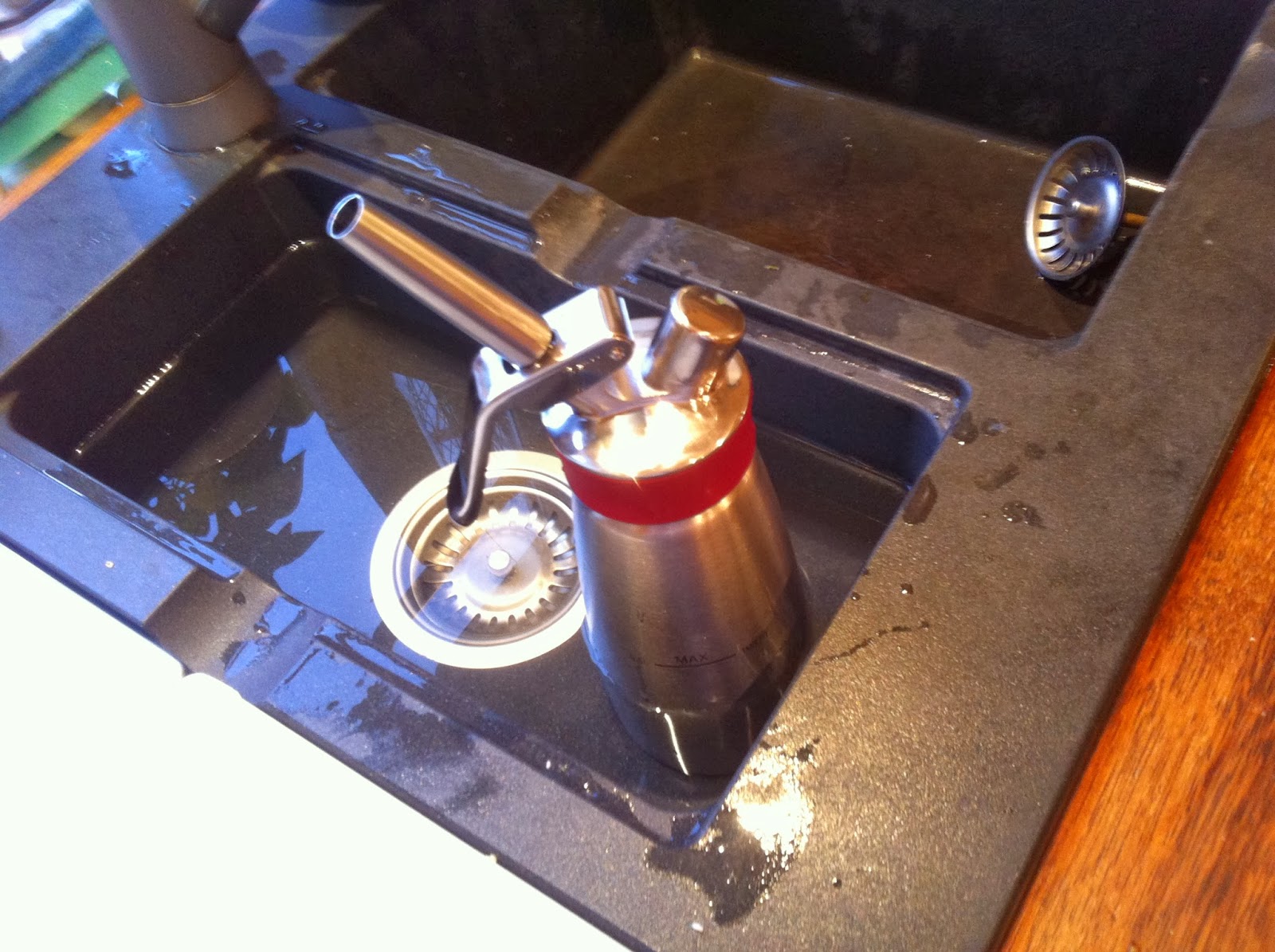
My sous vide bath was occupied with the main course (leg of lamb), so I had to make a make-shift manual one in my sink. I filled my smallest sink with hot water and popped in my oven thermometer and adjusted the temperature to 72 degrees. Then I had to manually add more hot water as the water cooled down. This, of course, did not make a very accurate system as you can see from the picture, but I managed to keep the temp reasonably within limits for the 35 minutes required.


The finished egg mixture was then added to a 0.5 l ISI whip which I loaded with one cartridge. I then kept the canister in the water bath (cooler than 72 degrees) until needed. I filled the omelettes with the shiitake mixture, piped out some of the foam, added some chives and rolled them together. I can report that my little starter had a very good and clean egg taste with the mushroom giving it depth and it was all very well received by my guests. I think this will be one of my favourite starters for the oversee-able future.


Wednesday, 18 September 2013

Modernist Cousine - brilliant future or pure bullshit?

I have been a hobby chef for ages. I have waded through the classics and been euphoric over local traditional dishes. But now I have become hooked on something new. It is called Modernist Cuisine. I have for some time been curious about this new thing, and I have and have read both the Fat Duck Cookbook and A Day At El BulliThe Fat Duck is the famous and innovative restaurant of famous chef Heston Blumenthal. This little restaurant in the little village of Bray in England has for many years been one of the most inventive places to chew the fat. El Bulli, led by cheFerran Adrià was for many years the restaurant that defined the new way of cooking. They closed a few years ago, but their legacy lives on.

When I got frightfully old last birthday, I were given presents that catapulted me into this new and exciting world of food. A sous vide machine and the tour de force of the topic: the book Modernist Cuisine: The Art and Science of Cooking. Or books. These five volumes total 2438 pages and weigh more than 23 kilos. I really don't know what to expect from this massive source of information. Many food enthusiasts have heard about these books, many wonder what they are, but few have read them. But now they are securely placed on the bottom shelf of my kitchen book shelf, and my intension is to read all of it. Or at lest almost all of it. And I assume that these pages will give me all the information to be had about this new and marvellous Modernist Cuisine. And I will try to write something about my findings as I harvest and hopefully utilise all this new information.

So what is modernist cuisine, anyway? After checking around the web a bit I found that many people have serious doubts about it. According to popular beliefs, modernist cuisine is all about making strange food using strange, possibly harmful ingredients and chemicals and strange, hi-tech equipment. And because of all this strangeness, one should not venture into it.

But from what I have gathered, modernist cuisine is about

  • moving the art of cooking forward by removing as many compromises as possible from the cooking process
  • exploring new ideas in food, challenging the ideas of what textures specific elements should have or indeed what those elements are, utilising new ingredients in the search of new textures and flavours
Cooking has always been developing. If people had not tried out new ideas, nothing of what we now consider traditional food would exist. And does really chemical belong in the kitchen? Well, they have been in the kitchen for ages, like baking soda or vinegar. And for strange, new equipment, we have already let the electric stove, blender and microwave oven into the kitchen, so why stop there?

So the way I see it, modernist cuisine is nothing more than another step in the evolution of cooking, perhaps using new ingredients and equipment, but nothing more outrageous than the new stuff we are already using. And as such, should we not pursue it? If there are new, exiting and possibly better ways of preparing food, should we not at least try them, and if they work, embrace them?

I say yes. It may not be the brilliant future, but it is absolutely part of the future, and it may even be a bit better. And more exiting. Time to start reading. 2438 pages are waiting.