Pages

Tuesday, 15 October 2013

Review: Hotel de Crillon, Paris


My wife and I went to Paris for three nights to celebrate our 20th anniversary.  After a bit of research, I decided on the Crillon for this occasion.  
This was based on the response I had after sending emails to several hotels including the Ritz, the Plaza Athene and the Bristol.  I chose the Crillon because they gave me a good offer and their response was somewhat personal.

  Hotel de Crillon is one of the old, well established palace hotels in Paris.  Actually, the building itself was built in the mid 1700s, but it did not become a hotel until 1909.  It is situated right on the Place de la Concorde at the bottom of the Champs Elysees.  Lots of famous people have stayed here, and it ended up on second place on Travel+Leisures list of the best large city hotels in Europe and #19 on the over-all list.  


After booking, I had an email from the hotel with a form to fill inn with my choice of pillows, duvet, what newspaper we wanted etc.  Nice touch.  I wanted tables at a couple of good restaurants, so a number of emails went back and forth between the concierge and me.  The concierge team suggested and subsequently booked some good places for me. However, I did find the correspondence with the concierge to be a bit stiff, awkward and not quite efficient.  Replies to my emails usually came as a formal document attached to an email.  This made it more difficult to quickly follow up with questions and comments.  Also, not all of my questions were answered.  Direct questions about booking was promptly answered, but a more difficult question about any activity the concierge could think of that would make our anniversary truly romantic and special was met with silence.

I had booked the hotels airport transfer, and we were met right at the gate by a nice and very professional young lady who guided us through the terminal building, helped us retrieve our luggage and took us to the waiting car that drove us in to the hotel.  

The check-in went very smooth.  Since we came at around noon, our room was not ready yet, so we went out for some sightseeing.  After a couple of hours we had a phone call from the hotel informing us that our room was ready, and we headed back.

  One word about the transfer.  When I booked, I had the choice between the above mentioned service at 260 Euros and the same with a bigger car at 315 Euros.  But later I learned that they also could supply a car to the airport door without following you in for 190 Euros.  


The offer I had included an unspecified upgrade from a superior room (the least expensive category).  I had also said I wanted a quiet room with a view.  We were very satisfied with the outcome.  We were given room #540.  This is a duplex suite consisting of a living room with a spiral staircase up to the bedroom and bathroom.  The room faces inwards towards the hotel courtyard, but due to it being on the top floor, the bedroom had a clear view across the rooftops towards the Eiffel Tower, thus both being quiet and having a view.  Perfect.  


The living room contains a sofa, coffee table and arm chair in addition to a few other tables and a cupboard containing mini bar, tv, music system and dvd player.  The bedroom had a large bed, ample closet space and tv/music system/dvd player and a safe.  The bathroom was quite large with a bathtub, dual sinks, a separate shower stall and separate wc.  The only drawback with the suite is that carrying luggage up and down the stairs is a bit difficult, at least with big suitcases, but this is of course done by the porter.


The general style of the hotel is grand.  There are 
lots of yellow marble throughout.  The atmosphere is not as stiff as one might fear, but it is a bit formal and old fashioned.  This is not necessarily a bad thing.  We had dinner at the Bristol on our second night, and that hotel seemed a bit lighter and brighter, but that is a question about personal taste. Generally, all of the staff were very friendly.  I especially want to mention the Front Desk Manager, Mr. Thorleif Tønseth who always did his best to make us happy and greeted us whenever he spotted us in the reception area.  The hotel struck me as being smaller than I had thought as it only occupies the left end of the building.


Now to the parts that could be better, and that centers on the restaurant Les Ambassadeurs.  The most annoying thing about the hotel was the fact that two out of three mornings, there was no room for us in the restaurant for breakfast and we had to wait in the Winter Garden just next to it.  This seemed to be quite a normal condition.  I do not think that will do for a hotel of this class.  On one morning we were offered to have breakfast in the Winter Garden, and even though that of course works, it was a bit awkward due to the low tables and soft chairs/sofas.  I think the hotel should re-think the Breakfast and possibly start using the other restaurant lObe instead of or in addition to Les Ambassadeurs.  


Food in Les Ambassadeurs was generally good.  We had dinner there the first night, three breakfasts and the Sunday brunch.  The tasting menu at dinner was very good and a bit less expensive than some of the other classy restaurants we looked at in Paris.  The Chef, Christopher Hache, just entered the position as the restaurant re-opened in April this year.  I do not know for how long they were closed, but I started wondering whether the waiting staff were new at that time, as this was the biggest problem at the Crillon. 


It started a bit during our dinner the first night.  It seemed that there was one team for breakfast/lunch and one team for dinner.  The dinner team was not all bad, but we started seeing small signs, like when my wife went to the lavatory, they came and took her napkin away, but never replaced it.  At the beginning of the meal we were asked if there was something we did not eat, and we informed the head waiter that my wife does not eat any seafood at all.  Two minutes later, an amous bouche with shellfish were served both of us.  

I think much of it came down to bad communication.  Also, after the head waiter found that we do not speak French when he took our orders, we were several times talked to in French by other waiters.  We generally found the service to be lacking in lots of details, and this became clearer as we dined at the Bristol the next day and experienced the perfect service there.


But it was the breakfast/lunch team that really was in need of some serious attention.  The service at breakfast and during the Sunday brunch went through three phases with me.  First a bit of curiosity at how they could be so sloppy, then irritation, and then amusement as I started observing what they did and tried to guess what would happen next.  

Breakfast at the Crillon is very good, but there were constantly items missing on the buffet. Dishes were empty for a long period of time.  Juice glasses were fought over for the short while they were to be found.  Two out of three mornings there was no butter on our table.  I ordered an omelet the second morning, which took 30 minutes to arrive and was clearly forgotten.  And after I had finished eating it, the toast that presumably was meant to go with it arrived.  When we finished a plate and went over to the buffet to get more, the used plate and cutlery was removed, but at times they forgot to give us new cutlery.  Generally I had a feeling that the staff was in a constant state of mild panic.  

I do not know what was the reason for all this.  It may have been that the crew was quite new and had not had time to become a real team yet.  It all was so consistently not good that I, as I said, at times found it amusing.  On the last breakfast I ordered another omelet.  I did this early in the meal remembering the time spent waiting for it the last time.  But this time it came promptly, and it was delicious.  As I have said, the food was generally good, so there is nothing wrong with the kitchen.

  And as we got up to leave after the last breakfast and I was still thinking of the nice omelet I had 30 minutes earlier, the toast arrived...


This review is from 2010.


Sunday, 13 October 2013

Eggs - the modernist way

Eggs are simple. Fry, boil, poach or scramble. Everybody have done it. Perhaps not poaching, but still. But perhaps there are better ways? As some may have read elsewhere in these chronicles, I have been bitten by the modernist cuisine bug and that has set me on a quest to find new and possibly improved ways of making the dishes that we know and love. Or not love. Scrambled eggs, for instance, is a dish that may be delicious or may be terribly dry and boring. I have especially had scrambled eggs from hotel breakfast buffets that I have doubted having been near hens at all. Good scrambled eggs should be light and creamy with a god egg taste. Not dry or pudding like.

Recently, one of my local TV stations here in Norway has been showing "How to cook like Heston". For any layman reading this, Heston is Heston Blumenthal, one of the best know chefs from the modernist kitchens. He runs his fantastic restaurant called The Fat Duck. To get a feel for what this restaurant is all about, have a look at these videos on youtube:

http://www.youtube.com/watch?v=VbviDzQmtbY
http://www.youtube.com/watch?v=d3REallhBz4

Unbelievable. I just need to go there some day. Anyway, the second episode of "How to cook like Heston" was all about eggs. What Heston does is to go outside the box to find new ways of perfecting his dishes. This involves using other techniques than you may be familiar with in order to achieve a better texture or flavour. All the recipes from the series can be found using this link:

http://www.channel4.com/4food/recipes/tv-show-recipes/how-to-cook-like-heston-recipes

Scrambled eggs á la Heston

I tried the scrambled egg variant where the eggs are cooked slowly in a bain-marie. The eggs came out wonderfully light and creamy. I cut the recipe in half, and that seemed to have an impact on the cooking time as well. The recipe calls for 15-20 minutes of cooking, but after about 7 minutes, my eggs took on a suitably consistency, so I took them off the heat and served.


I also tried out his way of making a soft boiled egg, but I must confess that the result reminded me suspiciously much of all other soft boiled eggs I have had in my time. I need to research that one more.


Omelet with French scrambled eggs and shiitake marmalade


For a more involved egg recipe I tried a variant of the omelettes on pages 144-149 in the book Modernist Cuisine at Home. The book has a rather complicated recipe which is also online here:

http://modernistcuisine.com/recipes/striped-mushroom-omelet-2/

Now, this recipe has an omelette with stripes of mushroom puree. I chose to not do the stripes this time to simplify things a bit. The omelette itself has eggs, extra yolk and heavy cream and salt.

It is cooked by first heating a pan and a lid in the oven, then pouring the egg mixture into the pan, and let it set in the oven with the lid on. This produces a rather flat, circular omelette. This was filled with shiitake marmalade (page 151 in the book) and the egg foam from the recipe in the link above. The marmalade is shiitake mushrooms finely chopped and  fried with butter, shallots, water, soy sauce and honey to a marmalade consistency that had a deep umami mushroom taste.


The foam calls for the egg mixture to be cooked sous vide. I have one of those vacuum machines where you stick the end of the bag into the machine and it sucks all the air out. In that process it will of course also suck out any liquids, so using that method to take the air out of the bag filled with the egg mixture would produce an empty bag and a ruined machine. In order to get the air out of bags with a runny contents, I learnt that a bag with a zip-lock is needed. Fill the bag and submerge it in water. As the water rises outside the bag, it will drive out the air. When just the zip-lock is above the water, close it and you have a nearly air free bag.


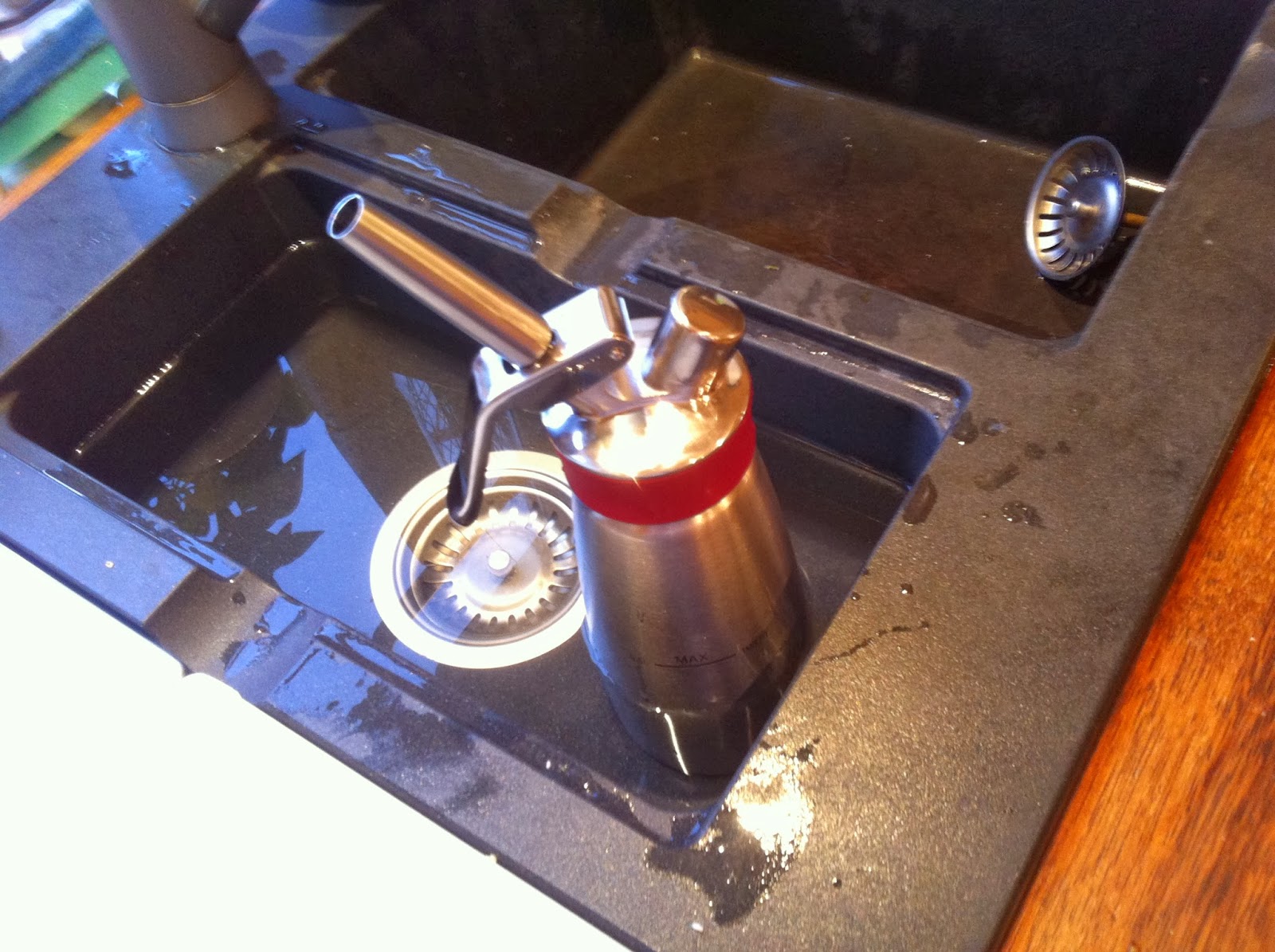
My sous vide bath was occupied with the main course (leg of lamb), so I had to make a make-shift manual one in my sink. I filled my smallest sink with hot water and popped in my oven thermometer and adjusted the temperature to 72 degrees. Then I had to manually add more hot water as the water cooled down. This, of course, did not make a very accurate system as you can see from the picture, but I managed to keep the temp reasonably within limits for the 35 minutes required.


The finished egg mixture was then added to a 0.5 l ISI whip which I loaded with one cartridge. I then kept the canister in the water bath (cooler than 72 degrees) until needed. I filled the omelettes with the shiitake mixture, piped out some of the foam, added some chives and rolled them together. I can report that my little starter had a very good and clean egg taste with the mushroom giving it depth and it was all very well received by my guests. I think this will be one of my favourite starters for the oversee-able future.


Wednesday, 18 September 2013

Modernist Cousine - brilliant future or pure bullshit?

I have been a hobby chef for ages. I have waded through the classics and been euphoric over local traditional dishes. But now I have become hooked on something new. It is called Modernist Cuisine. I have for some time been curious about this new thing, and I have and have read both the Fat Duck Cookbook and A Day At El Bulli. The Fat Duck is the famous and innovative restaurant of famous chef Heston Blumenthal. This little restaurant in the little village of Bray in England has for many years been one of the most inventive places to chew the fat. El Bulli, led by chef Ferran Adrià was for many years the restaurant that defined the new way of cooking. They closed a few years ago, but their legacy lives on.

When I got frightfully old last birthday, I were given presents that catapulted me into this new and exciting world of food. A sous vide machine and the tour de force of the topic: the book Modernist Cuisine: The Art and Science of Cooking. Or books. These five volumes total 2438 pages and weigh more than 23 kilos. I really don't know what to expect from this massive source of information. Many food enthusiasts have heard about these books, many wonder what they are, but few have read them. But now they are securely placed on the bottom shelf of my kitchen book shelf, and my intension is to read all of it. Or at lest almost all of it. And I assume that these pages will give me all the information to be had about this new and marvellous Modernist Cuisine. And I will try to write something about my findings as I harvest and hopefully utilise all this new information.

So what is modernist cuisine, anyway? After checking around the web a bit I found that many people have serious doubts about it. According to popular beliefs, modernist cuisine is all about making strange food using strange, possibly harmful ingredients and chemicals and strange, hi-tech equipment. And because of all this strangeness, one should not venture into it.

But from what I have gathered, modernist cuisine is about

  • moving the art of cooking forward by removing as many compromises as possible from the cooking process
  • exploring new ideas in food, challenging the ideas of what textures specific elements should have or indeed what those elements are, utilising new ingredients in the search of new textures and flavours
Cooking has always been developing. If people had not tried out new ideas, nothing of what we now consider traditional food would exist. And does really chemical belong in the kitchen? Well, they have been in the kitchen for ages, like baking soda or vinegar. And for strange, new equipment, we have already let the electric stove, blender and microwave oven into the kitchen, so why stop there?

So the way I see it, modernist cuisine is nothing more than another step in the evolution of cooking, perhaps using new ingredients and equipment, but nothing more outrageous than the new stuff we are already using. And as such, should we not pursue it? If there are new, exiting and possibly better ways of preparing food, should we not at least try them, and if they work, embrace them?

I say yes. It may not be the brilliant future, but it is absolutely part of the future, and it may even be a bit better. And more exiting. Time to start reading. 2438 pages are waiting.


Wednesday, 14 August 2013

Actors - Magical people

I have a close, young relative who is more than averagely interested in Harry Potter. According to her, there are people with magic abilities. Most people are muggles, but some are witches and wizards. I have actually spent quite some time trying to persuade her that Harry Potter is a fictional character and that magical people do not really exist. Lately, however, I have come to the conclusion that I have been wrong. Magical people do exist. They are actors, and they perform magic every day.

I work in the film business. I am a Visual Effects Supervisor. Visual effects are the film effects that are produced as part of the post production of the film and may be anything from replacing the sky with another sky to making it look like nighttime even though it was filmed during the day to adding dragons or making something that was filmed in front of a greenscreen look as if it was filmed in space. Being a visual effects supervisor, one of my tasks is to be on set during filming, making sure that everything is done the right way so that we can do our job later on. And that is where I meet them, the actors.

When I work on a movie, I start by reading the script. And even though I read it in a somewhat technical way to find out what effects needed and how we should go about creating them, I try to envision what the movie is actually going to be like. I mean, it is all there in black letters on white paper what is happening and what the characters are saying. The director often adds some information and visions to what is actually printed, but even so, it is rather clinical and sort of dead. It is difficult to be emotionally aroused. The actions and spoken lines remain only printed words on a page. Why? Because I am not magical enough. I am not an actor.

I had read the script for the last movie we did a number of times. A great number of times, actually. I had been involved in the project half a year before anything was filmed. The movie was about characters who walked around and said and did stuff, but they were not real. They had no life. They were not people. Then we started filming and the actors came on set. And suddenly the characters from the script were there, right in front of me. The characters that I had seen on the pages of the script for months had suddenly leapt off the page and started living. They had a personality, a voice and a way of doing things. And all this was born inside the head of an actor who had read the same script that I read, but who had managed to see through the paper and found a living person there.

Ok, so he had also had help from the director, who also is a magical person, but it was inside the actor that the character has been given life. He was born by the writer, had the director as a nanny, but grew up inside the the head of the actor. It is as if a person was born and has had all of his life inside the actor, and now is being released into the world.

And with many actors, this character grows to become more than he was as written words in the script. It is as if what is written is only a point in the life of this character and I get to see the character pass this point and move further. Some actors do not need much of a script at all. A few words on a piece of paper, and the actor can build a whole world out of it. I have watched scenes where the character passes the script point during the rehearsals and have gone on to a much fuller and richer life than anyone had imagined by the time the last take of the scene has been captured by the camera. That is magic. They are magical. They are actors.

Thursday, 8 August 2013

Staying at the Savoy - Last day, the verdict


Check-out

It is always difficult to see something that is not there. You may think that is a rather peculiar sentence and that I have been to the American Bar again having more than four of their "Corpse Reviver No2" this morning, but I have not. What I have done is to open our guest room door here at the Savoy and found the Times hanging neatly in a leather bag on the door. In hotels like the Savoy you often get a free (or shall we say included) newspaper. That is when I realised that we did not have our newspaper yesterday. But I did not notice since it was not there. So it does actually make sense. I am a little surprised that the staff at the Savoy failed in such a simple act as hanging our leather newspaper bag on our door when the task is basically to hang one on the door of every occupied room. On the other hand it is in a way good to be able to fault them at some minor things so that these posts do not appears as pure and utter promotion for the hotel. 

So we have reached our last day at the Savoy hotel. I have asked for and been granted a late checkout at 4pm. I originally thought that it would be difficult to let me have the room that long, but I have learned the Savoy way now. Nothing is difficult. I have also read on the web that people have been charged extra for late check-outs. And, indeed, in the in-room information folder it says that if you want a late check-out, you should call reception and they will provide you with availability and rate. I think that within reason, late checkouts should be complimentary if available. And I find that it is in many places. The good thing is that I have been granted my rather late one for free. 

There is a thick envelope stuck in under the door this morning. This turns out to be a copy of my account and a letter about how to checkout. I was actually wondering about that. How do you check out if there is no reception counter to go to. Well, as you may have learned from yesterdays blog post, it should be as easy as going down and talking to one of the staff members in the Reading Room or Front Hall. It would probably suffice to go down, stand still and look lost, and they will come to you. But as I read the letter I find that I did not have to worry. Check-out may be done the Savoy way, meaning the way you want it to be done. I can


  • Go down to the reading room and talk to a member of staff
  • Fill out the express check-out form supplied in the envelope
  • Check out via the television
  • Check out by telephone
  • Or, my favourite, just send an email saying you are leaving and then just leave and they will email you your final invoice

I must admit that I prefer the human touch, so after spending the day strolling around London, we pack our bags, call down to have someone come pick up our luggage and walk down to the Reading Room. Check-out complete, we walk out of the revolving doors for the last time. Outside our luggage is waiting for us. The doorman promises to do some exercise so that he can accompany me on my run next time we are here. We look dreamily at the S8 VOY, the Rolls Royce Phantom that decanted us on the doorstep of this great place two and a half days ago, grab our luggage and start walking towards the tube. Our magical Savoy encounter has ended, everyday life has been resumed.

The verdict

So, have I found my perfect hotel? Looking back to one of my earlier posts here, I see that I then defined my perfect hotel as being

"The hotel where I can soak up tradition and atmosphere, marvel at the thought and care that went into making the place, feeling at home and cared for and generally experience a touch of magic in the midst of all of life`s boring sides."


I can now truly say that the Savoy meets these criteria. It is positively dripping with tradition and atmosphere. And the recent restoration work has produced a hotel that while echoing the grandeur of the past also appears new and crisp. The location is great, especially for theatres. Our room has been as good as any I have had in any of the top hotels we have stayed in. All food and drink that we have had was of a very high standard. In addition to our tradition of coming to the Savoy for afternoon tea every time we are in London, I may take up a new tradition of going to the American Bar as well. 


But, as I have tried to make exceptionally clear in my previous posts, it is the people that work here that really makes the Savoy a special place. The absence of the reception counter, that barrier that so often separates the staff from the guest, makes interacting with the Front Hall staff very personal. And all the little details that are in place and that I also have described earlier make the whole experience even more welcoming and warm. There is nothing of the snottiness that I have seen in other famous hotels. Some times you encounter staff who know perfectly well that they hold an important position in an important hotel, and they want that to come across as much as possible. Nothing of that here. 


We did not experience the butler service this time as this is something that comes with staying in a one bedroom suite or above. I would truly like to test that out as well some day. Perhaps for our 25 year wedding anniversary in a couple of years. These suites are of course rather expensive. Searching for a random night a couple of months from now, the standard rate for a one bedroom suite is 1194 pounds per night, and in my world that requires a very special occasion indeed. But for that price you get a few extras:

  • Butler service
  • Transport to and from the airport
  • Lokal dropp-offs with chauffeured car
  • Beverages from the in-room bar
  • Pressing of one garment per person
  • Wifi

So you get quite a lot, but it costs a bit, too. But with my passion for personal service, I feel I need to test the butler service. Some time. We will see.


Was everything perfect in every way? Well, for the important parts, yes. There have been a few flaws as I have pointed out. 

  • When we had not eaten all the fruit that we had ordered (and paid for) and left the rest to eat later,  the rest was removed for no obvious reason. I think this was the most severe fault during our stay.
  • They charge extra for wifi. I do believe that I have made my view on that topic perfectly clear in my previous post.
  • We did not get our newspaper on the first morning.
  • Since we were arriving in the hotel car, the doorman should have been able to just welcome us by name in stead of asking my name. This is not a flaw, but an opportunity to add even more magic to the experience.


So, was it perfect? Well, it was pretty close anyway. I am sorry to say that yes, it is as perfect as it probably gets. Why should I be sorry about that? Because there are more hotels that I would like to try. There is Claridges and the Connaught, we should re-visit Browns again after their refurbishment and we should also try the Ritz again after our less than perfect stay there some years ago. But now all logic tells me that I should return to the Savoy and if I stay anywhere else I would feel as if I were cheating on them. 


How can I sum it up in a few words? Reading through all my posts, there are some words that i seem always to come back to. 

Elegance, tradition, warmth and friendliness. 

That, to me, is what the Savoy is.

Wednesday, 7 August 2013

Staying at the Savoy - Day two, service and a small crime


Service - the human touch

There is something very special with the old hotels in London. The buildings themselves radiate grandeur, tradition and history. They provide a feeling of solid luxury that has survived the ever changing whims of passing decades and confidently invite us into a world that still is the epitome of elegance. And they can do this because they in many ways defined elegance, luxury and the good life back in the days and they know it still is valid. And the really good ones manage to do this and still feel fresh and updated. This, of course, is especially true for the Savoy which emerged from a total restoration a few years ago and now stand before us old, but brand new. Walking in through the revolving doors is like being taken back in time while taking the present time with you. I am taken into a different world, a parallel universe and it is even as if I am transformed into another person. Perhaps even a better person. And if the best way of enjoying a holiday is to do something different, what could be better than spending that holiday in a entirely different world?

So is that the recipe for making a great hotel? Erecting a building that has certain qualities, looks good and make people go "wow" as they walk in the door? Well, it may be a good start, but it is just a small part of it. And it is even the easiest part. All it requires is enough money. If you throw a huge enough fortune at a building, you can always make it look good. The Savoy recently tried and succeeded when they closed down in December 2007 for a restoration period that lasted until October 2010 and cost  £220 million. But that is not enough. I guarantee that I could take over that gorgeous building and transform it into an absolute terrible hotel without any difficulties. No problem. Because the real valuable assets in great hotels are the people working there, not the building. And the systems they have put in place that allows these people to bloom and flourish. The most important part of a great hotel will always be the human capital.

Nowhere have I seen this more than at the Savoy. Or felt, actually. It gives a feeling of well being, of being looked after, a feeling of being seen and appreciated. It starts with the friendly greeting from the doorman as you arrive. It continues with the warm welcome of the staff member that greets in the Front Hall, and it never stops. Everyone I meet are smiling, warm and friendly. I feel like I want to stop and chat with them, be friends with them. And when I do engage in a bit of small talk, it turns out that they are good that, too. And that is an art form. Being able to conduct a random, but meaningful conversation with anybody. And nothing seems to be any trouble at all. There is a feeling of abundance and generosity. Even though you of course know that you are paying for this. But seeing and feeling that your money is being put to good use helps.

I often read about hotels where the staff remembers your name so that they can address you using your name all the time, and I have always wondered how that would be possible. I have also read that about the Savoy, and I was eager to see it in action. Well, to all of you who now await the solution to the mystery, it did not happen. And how could it? I mean, the Savoy has 268 rooms. If all the staff knew all the names all the time, I would be scared. It only shows that they are human after all. And I must admit that even though many of the staff introduced themselves to me, I can not remember any of their names. But I do believe that if we had stayed more than the two nights, some of the staff would start calling me by name, because I really think they try and want to. And I believe that it will happen easier here than in many other hotels because I feel that one interacts more personally with the staff here.

On this, our day two of staying at the Savoy, I am walking through the hotel noticing the big and small details that are in place allowing the staff to produce this feeling of personal service. Small things like, as I mentioned, they all present themselves by name if you interact with them for more than a few seconds. Also, a small incident in the American Bar as we visit there again this evening shows what I now think of as the small but valuable Savoy ways of doing things. As yesterday, we are escorted to a table by a young lady. She asks my room number and name, but this time saying "Can you remind me of your room number, please." I take that as a sign that she recognised me from yesterday, but could not  for obvious human reasons remember my number and name. Perhaps she would if we had come in the next day as well. Anyway, she goes away and enters my data into some kind of system. Then the waiter comes over. We did not see him yesterday and I doubt that we made such a remarkable appearance that he noticed and memorised us. But he has probably checked the same system and have seen that the same number and name was in here yesterday, so when he comes to our table he is able to say "Welcome back, mr. Moen". Nice.

There are numerous other small details that add to the experience. As I go out running today, I chat a bit with the doorman before setting off. I ask him to come with me, but he declines as he is needed where he is and the top hat would be impractical. And when I return, he is ready with a bottle of water for me. Also nice.

But I think that one of the most important reasons why it all feels so close and personal is not a small detail, but has to do with an important structural change that I believe was done during the rebuild of the hotel. As you walked into the Front Hall before December 2007, you would find to your right what usually defines the reception area of most hotels: the reception counter. The counter over which business transactions are made, which gives a rather formal feeling to the whole setting and that acts like a barrier between the guest and the staff. One thing that happened during the rebuild was that this counter  and barrier disappeared. Now you will find a small desk for the concierge in the same spot.

So where do you go when you need to interact with a member of staff? You have two options. The easiest and most pleasant as you stand there, facing the missing counter is to turn around. And there they are. There are always one or two staff members hovering in the middle of the room. Ready to greet new arrivals or to help anyone that approach them with anything. And as you turn around, chances are that one of them will already have noticed a guest in need and approaches you. And this one-on-one interaction, standing right next to a fellow human being as opposed to talking to a head master mounted behind his desk I think is a vital part of the experience. And if your business requires paper work or the use of a computer terminal, he or she will direct you to the Reading Room for further assistance.

Very nice.

The Savoy Grill


Tonight we have booked a table at the Savoy Grill. The Savoy Grill is an old institution in London. The restaurant was also restored to previous glory as part of the total rebuild of the hotel. It now emerges as an elegant art deco room dominated by huge crystal lamps in the ceiling. As we enter at 7pm, the room is bustling with life. The restaurant is reasonably full, and it seems to fill up entirely during our meal. As we are seated at one of the tables by the inner wall with a good view if the room, we notice that it is absolutely on the chilly side in here. We mention this to the person handing us the menus, and he sets off to deal with the air conditioning. And within a short time, the temperature actually becomes more comfortable.

The menu is dominated by traditional, no-nonsense dishes like steaks, braises, roasts and pies along with good starters and seafood. No modern rubbish, but tradition and quality. My wife orders the onion soup, an attempt to fight off the chilly temperature before the air conditioning is adjusted. I go for the farmhouse terrine with foie gras parfait and green tomato chutney. For our main course we choose the whole roasted Goosenargh duck with artichoke gratin and duck jus. The sommelier suggests a good Bordeaux to complement the duck and sets off to decant it. 

The starters are very good. The duck is then brought to our table whole for us to see before it is once more taken to the kitchen to be carved. It is served as slices of breast and one leg per person. The breasts are beautifully pink, perfectly cooked, tender and with a great taste. The legs remind me of duck confit. Tender, cooked through and the meat almost falling off the bones. As an amateur cook I wonder how they managed that. Pink breasts and legs cooked perfectly. My suspicion is that the legs did not roast with the breasts, but were cooked separately, but I am no expert. We have ordered new potatoes and creamed spinach as side orders, but it turns out that there was no need. The artichoke gratin would have been sufficient.

For desert we go for the Strawberry and almond millefeuille with elderflower ice cream. It is cut table side from a big piece and is absolute delicious. After the desert has been dealt with, we are presented with petit fours. Two pieces each. By now, we are starting to become seriously full. We make sure the bill is put on our room and prepare to leave. Bur our waiter asks us to stay a few minutes and leaves us. Then she returns. The fact that we are here at the Savoy to celebrate our recent 50th birthdays has trickled into the Grill as well, and we are each presented with a small, but filling piece of cake on plates decorated with "Happy Birthday" in chocolate. Somehow we managed to swallow that cake as well. We leave with a rather slow gait.

A smal crime

So is there nothing bad to say? Not much, but there is one thing. One rather serious thing in my opinion. Something that irritates me profoundly. The Savoy charges extra for wifi. There is a daily charge of around £9.50 for the use of the hotel's wifi. I view this as a serious flaw. In the year 2013 hotels do not charge extra for wifi. One just does not. In this day and age I regard this as a small, but serious crime. It is easily dealt with, however. Register in the Fairmount President's Club, and wifi is free. Membership is free as well. But still. It is not the Savoy way. It is out of character. 

Stop it! 

Now!


Tuesday, 6 August 2013

Staying at the Savoy - Day one, the big Savoy magic trick


Checking in

As I mentioned in my previous post, the first few minutes of anything are the most important ones. This is true for movies and hotel experiences alike. And the Savoy has fully understood this idea and aims to dazzle you right from the start. And it works, too. As we step out of the car and is welcomed by the top-hatted doorman, he asks my name. And as our luggage is taken into the luggage elevator, the doorman guides us in through the revolving doors into the front hall. There he hands us over to a smiling young man, and this young man knows who we are! And he has our papers ready. This is the big Savoy magic trick. What happens is that as I tell the doorman my name, he repeats it and the information about the incoming guest is broadcast from his microphone to the inside of the hotel. Neat and effective and also a hint at the small details that we will learn is an integral part of the Savoy service.
It could have been even more magical, though. Since we were arriving in the hotel car, booked through the hotel, and the chauffeur called in to tell that we were coming as we was nearing the hotel, the information about who this guest was could this time actually have gone the other way, out to the doorman. so there is actually room for improvement there.

But back to the smiling young man in the front hall. We are led into what is known as the reading room where we are seated in front of a desk where forms are signed and welcome information is given. He then gives us a tour of the place. For an overview, see this post.

After having been informed of the whereabouts of the different parts of the house, we are led along a thickly carpeted corridor adorned with small tables with vases and flowers, pictures on the walls and polished, brown doors along the walls. We stop outside room 216, the door is opened for us, and we enter our Savoy guest room.


The room

I booked a Deluxe King which is the second least expensive category, the least expensive with a king size bed. We have clearly been upgraded as this room has a large window out towards the river. Since we are on the second floor and since the trees are thick with foliage, we see more threes than river, but there are glimpses of it, the trees are nice and we can also see parts of the London Eye. The room is big for a London hotel room, the high ceiling and large window gives it a spacious and airy feel. It even smells good. Actually, the entire hotel smells good. I believe they actually cent the rooms and common areas in order to make sure guests are met with pleasant odours. I noticed the same when staying at the Dorchester some years back. A distinct feeling that the hotel had been perfumed. Well, why not. There is nothing worse than checking into a foul smelling hotel.

Furniture consists of

  • a king size bed
  • one arm chair with a small table
  • two night stands, one on each side of the bed
  • a writing desk with chair
  • a cabinet holding what they call the refreshment centre, looking like a chest of drawers but containing the minibar and lots of chocolates, biscuits etc.
  • one bench at the end of the bed
  • one small table in the hallway
One bed stand has an iPod/iPhone docking station with speakers so that you can play your own music through that. The other has a small but fine clock. A very nice touch. There is ample wardrobe space. One cupboard with hangers in the room, one with hangers and one with drawers in the hallway. Lighting is good, but there could have been better reading light next to the bed.

The bathroom is quite big. Two sinks to the right, bath tub to the left, two frosted glass doors straight ahead, one leading to the toilet and one leading to the shower. Good products, nice, thick towels.

All in all this is a very nice room, spacious and with good light and a view. We do notice a bit of noise coming from the street due to not really sound proofed windows, but later on we learn that the thick curtains removes most of the sound when drawn.

Our guide shows us around and then leaves us to settle in. Our luggage is delivered shortly afterwords by a smiling young man who asks if there is anything else he can do for us. And after he has left, room service brings a few items that I have pre-ordered. I have ordered a bouquet of flowers for my wife and some fruit and water. The fruit has clearly been polished and looks very nice. We eat some of it and leave the rest for later. So far, the staff has been exceptionally warm and friendly. A good start!

Afternoon Tea

Afternoon tea is a British institution and one that we try to be part of every time we are in London. Tea may of course be taken in many places, but to experience the real deal, I suggest you try out the big tea happenings at one of London's better hotels. We have so far had tea at the Ritz, the Dorchester, Browns and the Savoy. We found the Ritz to be a bit stiff, the Dorchester was nice and grand, Browns cosy and homely provided that you live in an elegant British country house and the Savoy, we feel, is elegant but relaxed.

I have booked afternoon tea for us at 15:45. That may seem like a strange time. Why not 16:00? Because it seems they have certain fixed times you can book, and around the 16:00 mark, the available time is 15:45. Our table is next to the huge cage-like structure that encloses the grand piano. Our waiter for today is a nice, young woman who explains the procedures to us. Since we have been here a number of times for tea, we know the drill.

You can choose between two different meals. Traditional afternoon tea and high tea. The difference is that high tea also consists of some savoury dishes, not only the sweet ones. We go for the sweet, traditional, every time. Traditional afternoon tea is priced at £42.50. Newcomers may think that £42.50 is rather steep for a cup, or even for a pot of tea. But tea is only one small part of this. But apart that is taken very seriously. I counted 28 different types of tea on the menu. Some of them are rare and cost extra. And when you are at it, you may also have a glass of champagne. 

After choosing the type of food, type of tea and champagne or not, the first course is placed on the table. This is a three tiered stand containing 5 different types of sandwiches, scones with and without raisins, clotted cream, strawberry jam and lemon curd. Tea arrives in silver pots and are poured in china tea service especially made to complement the room. The sandwiches are really tasty, the flavours are enhanced with the help of herbs and spices. The scones are the best scones we know. Smooth and light. 

When we have eaten all the sandwiches and scones, our waiter asks if we want more of them. We do. But not too many. We know what is in store for us. After the cake stand has been cleared away, it is time for fine french pastries. Our waiter presents a tray with six different, artfully presented small cakes. They are beautiful to behold, and they are not too sweet, but are packed full of flavour. You may have as many as you like. I tried to have one of each once. That turned out not to be a good idea. And after you finish with the pastries, there are three signature cakes to choose from. This is normally when a slight nauseating feeling is starting to creep in if you asked for refills on the sandwiches and scones and chose too many pastries. 

When I booked our stay at the hotel, I informed them that we are here to celebrate our recent 50th birthdays. This information has been passed on to the staff in the Thames Foyer. Towards the end of our meal, ours and other birthday tables have a special piece of cake with a candle while the pianist plays "Happy birthday to you". 

All in all the traditional afternoon tea is a substantial meal. If you have dinner plans later on the same day, cancel it. After you finish the meal you will wish that you could just take the elevator up to your room and collapse on the bed. This time we could. If we cannot afford to stay at the Savoy every time we are in London, we will always be coming back for afternoon tea. It is always good and the service is very friendly and effortless. You can watch a youtube video about the Savoy afternoon tea here.

The American Bar

We have tickets for Billy Elliot tonight. Dinner is out of the question since massive amounts of cake is competing for space down there, so we decide to try out the American Bar for a drink before we set out for the theatre. 

From their web site:

"The American Bar is widely regarded as one of the world's best hotel bars with a history that harks back to the golden age of cocktails in the 1920's."

A nice, young lady leads us to a window table, asks our room number and name and hands us the menu. I must admit that we do not frequent bars very often, and neither of us majored in cocktails, so the amount of items on the menu feels quite overwhelming. There is a huge section for cocktails, sections for champagne, wine and sections for every conceivable type of spirit. But we are here for the cocktails which is what the bar is famous for. The cocktail pages are divided into several sections as well. There are
  • American Bar legendary bartender’s signature drinks 
  • Morning bracers, fog cutters and revivers
  • Bon vivant, social libations, cups and cobblers 
  • Aperitif and pre-dinner drinks
  • After-dinner, night caps, and ‘one for the road’ cocktails
  • Vintage cocktails
Drinks are mostly around £15, but the Vintage cocktails seem a bit special. They start at £80, and the most expensive of them is £5000. Wow! I wonder how many they sell of those.

Fortunately there is a today's special as well, and right now that is a cocktail called "Third in line" celebrating the newly born prince. It actually contains yoghurt in addition to the spirits and other ingredients. The order goes out to our waiter, and a short time afterwords he comes back with to glasses with white content. It really tastes very fresh and is very good. From where we are sitting we have a clear view of the bar itself where the bartender does his magic. There is quite a bit of theatre about a good bartender. And watching him work his shaker is as good entertainment as anything else. 

Drinks finished, we make our way to the Victoria Palace Theatre for Billy Elliot, which turns out to be a very good show.

The great fruit robbery

As we get back from the theatre, we note that the maid has been in and turned down the room. The curtains have been drawn, the duvet pulled back, slippers at the ready by the bed and a bottle of water placed on each night stand. And the room has been generally tidied. But one thing is missing. Our fruit. We had left most of it to be had tomorrow, but now it is all gone making what we had easily the most expensive apple in the world. I can see no good reason to remove the fruit. It should clearly have been left on the small table. The used plates and knifes might have been replaced with new ones. One scratch in the otherwise perfect first day at the Savoy.